Architecture
Conceptual Ecosystem Architecture
Agent Manifest is part of a broader declarative infrastructure for AI agent identity and interaction.
The ecosystem architecture is illustrated below.
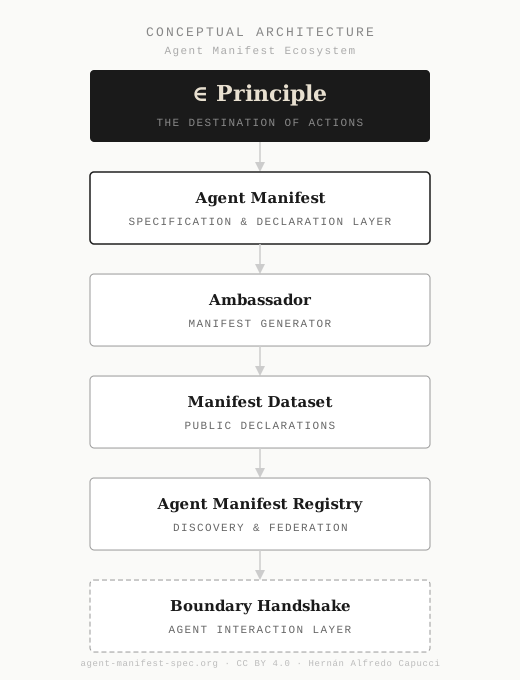
This document focuses specifically on the internal architectural constraints of the specification itself.
Agent Manifest is a minimal specification that operates strictly at the Declaration Layer.
It does not execute agents.
It does not enforce policy.
It does not validate runtime behavior.
It standardizes how boundaries are declared prior to execution and interaction.
Layered Separation
Agent Manifest is designed around strict separation between three layers:
1) Declaration Layer (this repository)
Defines a shared declaration surface for:
- Identity and purpose
- Scope
- Autonomy level
- Tool access scope
- Risk profile and declared boundaries
- Data handling commitments
- Human oversight conditions
- Version declaration (
manifest_version)
This layer is declarative and execution-agnostic by design.
2) Enforcement Layer (external systems)
Independent systems may interpret and verify declarations, including:
- Validators (coherence / contradiction detection)
- Policy engines (rule-based enforcement)
- Audit and compliance tooling (attestation / reporting)
- Governance overlays (institutional requirements)
These systems are not part of this specification.
Agent Manifest enables enforcement tooling by providing structured declarations, but it does not embed enforcement logic.
3) Execution Layer (agents and runtimes)
Execution systems perform actions and may reference a manifest, including:
- Tool-calling agents
- RAG agents
- Orchestrated workflows
- Multi-agent systems
Execution behavior is out of scope for Agent Manifest.
Design Constraints
Agent Manifest must remain:
- Minimal (small surface area)
- Composable (usable across domains)
- Execution-agnostic (no runtime coupling)
- Policy-agnostic (no embedded governance engine)
- Forward-compatible (refinement over accumulation)
Scope is fixed at v1.0; subsequent changes refine clarity rather than add features.
Extensibility Boundary
Extensions may exist, but outside the constitutional core.
Examples of external extension domains:
- Domain-specific boundary profiles
- Sector compliance overlays
- Risk classification schemas
- Validator interpretation layers
- Interoperability conventions between agents
Extensions must not modify constitutional guarantees defined in CORE_PRINCIPLES.md.
Non-Goals
Agent Manifest does not aim to:
- Provide safety guarantees
- Certify or score agents as “safe”
- Replace governance frameworks
- Define runtime architectures
- Define or replace agent frameworks
It defines declarations.
Everything else is external.
Architectural Integrity
The separation between the three layers is normative.
- Declaration (Manifest)
- Enforcement (validators / policy / audit)
- Execution (agents)
A declaration is a precondition for third-party verification.
Conceptual Foundation
The specification is grounded in Pre-Execution Authority:
a boundary-first doctrine where authority and constraints are declared prior to autonomy and execution.